Brandscapes Worldwide and Ai Palette have announced a global partnership that would accelerate deployment of Ai & ML led insight and innovation solutions for their clients around the world.
Ai Palette’sForesight Engine identifies trends as they just emerge and understands the consumer needs that drive those trends. The engine uses advanced Ai and ML algorithms to measure the maturity of trends and predict their future trajectory.
Through InnoScapes, an innovation accelerator service, Brandscapes Worldwide helps global clients sharpen their innovation strategies to launch new products or renovate existing ones.
“Ai Palette’s Foresight Engine for spotting early consumer and category trends is a powerful way to sharpen and accelerate innovations – and would neatly dovetail into our InnoScapes suite. We are excited about taking this solution from Ai Palette to our global clients,” said Pranesh Misra, Global CEO, Brandscapes Worldwide.
Ai Palette Co-Founder & CEO Somsubhra GanChoudhuri says, “The Brandscapes partnership gives us the opportunity to deliver on our mission of helping CPG organizations create successful products and bring them to market in months, not years. We look forward to enhancing the Brandscape suite of solutions with real-time insights that help customers make strategic business decisions using real-time data.”
Brandscapes Worldwide is a global insights and analytics company that works with 100+ Fortune 500 companies in Food & Beverages, Consumer Goods, and Financial Services, helping them with insights and analytics tools for business decisions. Brandscapes’ network of offices and affiliates cover USA, UK, UAE, Turkey, Singapore, Myanmar and India.
Ai Palette helps CPG manufacturers launch their next best-selling product in months, not years, by spotting and predicting consumer trends in real time. Its AI-powered platform derives consumer insights in 15 languages (and counting), making it the most comprehensive of any Ai-powered trendspotting tool. Ai Palette serves customers around the world.
Perspectives by Brandscapes is an initiative where we converse with industry leaders about their experiences and points of view about marketing, insights & analytics.
Perspectives by Brandscapes is an initiative where we converse with industry leaders about their experiences and points of view about marketing, insights & analytics.
Fathers are the superheroes who work hard day and night to keep their families healthy, often overlooking themselves to fulfil the dreams of their families.
This year let’s look at how Brandscapes uniquely celebrated Father’s Day by asking colleagues to share what being a father means to them.
Brandscapes Worldwide joined hands with Annam to raise awareness and bring hope on Mother’s Day to some underprivileged mothers. Brandscapes successfully fed 200 disadvantaged mothers in May 2021 to mark Mother’s Day
Mother’s Day is the celebration that honours such unbelievable selfless humans that take care of us and nurture us through our lives. The day is celebrating the contribution of mothers and acknowledges the role of mothers in our society.
The ESOMAR APAC conference invites world-known brands and
companies from Asia Pacific and beyond to take to the stage and share their
knowledge and experiences of a modern data and insights ecosystem. This year’s
online festival featured more 30+ thought leaders representing: Australia,
China, Hong Kong, India, Japan, Malaysia, Philippines and Singapore: a
colourful combination of global brands and research agencies fueling your
inspiration and insights knowledge.
Jayanth Narasimha, Associate Vice President and Maitreyee
Patki, Director – Insights were shortlisted from over 150 APAC entries, and
further shortlisted to present at the virtual format of the conference.
Their paper ‘Sustainability: Doomed If You Do, Doomed If
You Don’t’ focused on putting the spotlight on packaging, the biggest
contributor to the plastic pollution problem, and breaking the communication
deadlock between businesses and consumers through packaging design solutions.
There are numerous reports by established research agencies on the UK payments landscape. Despite giving a direction and an indication of consumer’s financial holdings and payment behaviour, they fail to provide the depth and breadth needed to truly understand consumer’s perceptions, attitudes, and actual behaviour. The payments industry is complex; and a multitude of factors affect how consumers pay, such as:
Personal factors – age, life-stage, and affluence.
Financial factors – personal financial situation, financial holdings, financial institutions, and their product offerings.
Financial evolution of the consumer – sequence and ‘ageing’ of acquisition of payment modes.
Business environment – consumer confidence, merchant acceptance, technology, and digital adoption.
Therefore, it is challenging to get a complete view of the payments landscape. The intricacies of the four-party payment model (consumers, payment brands, banks, and merchants) mean that each stakeholder only sees the data they collect and never gets to understand the full picture.
Within the plethora of data sources used across Visa and its clients, there was no single source which looked holistically at consumer financial portfolios. Typically, there was a focus on one aspect e.g. debit or credit and therefore a gap in our understanding of consumers payments in their entirety.
The challenge was to develop a single, robust view of the consumer payments landscape that can be used by the entire UK Visa business and all clients.
Additionally, there was a second challenge in the methods of research used. Traditional qualitative methods rely on claimed behaviour which has a lag between the actual event and reporting it, which leads to inaccurate and rationalised biases. Quantitative methods give an in-depth understanding of what is occurring, but little context as to why and again included biases as consumers are forced to re-evaluate and rationalise their behaviour.
The Project
Brandscapes designed the Consumer Payment Landscape (CPL) research with Visa to overcome these shortcomings. Given the multitude of data sources already existing in Visa, it was important for the research to build on what Visa and its clients already knew, and bring all internal stakeholders onto the same ‘page’ through a multi-lens approach.
The goal of the research programme was to build the most comprehensive and detailed view of the UK payment landscape by understanding consumers ‘real’ payment attitudes and behaviours.
“It was critical from the outset that the research built upon existing knowledge whilst gathering new intelligence to create an unbiased view of the UK payment landscape. We needed a solution that triangulated existing datasets with extensive quantitative results of real-time purchasing behaviour along with a qualitative perspective to provide a true 360-degree view of the payment landscape.” Damion Lawrence, European Head of Research & Insights, Visa Europe
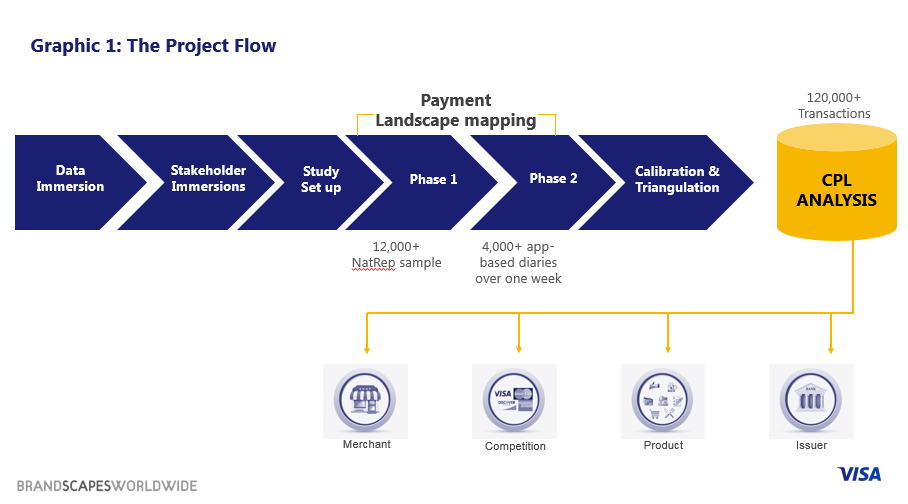
As befits such an ambitious exercise, a multi-stage and multi-modal approach was designed as shown in Graphic 1.
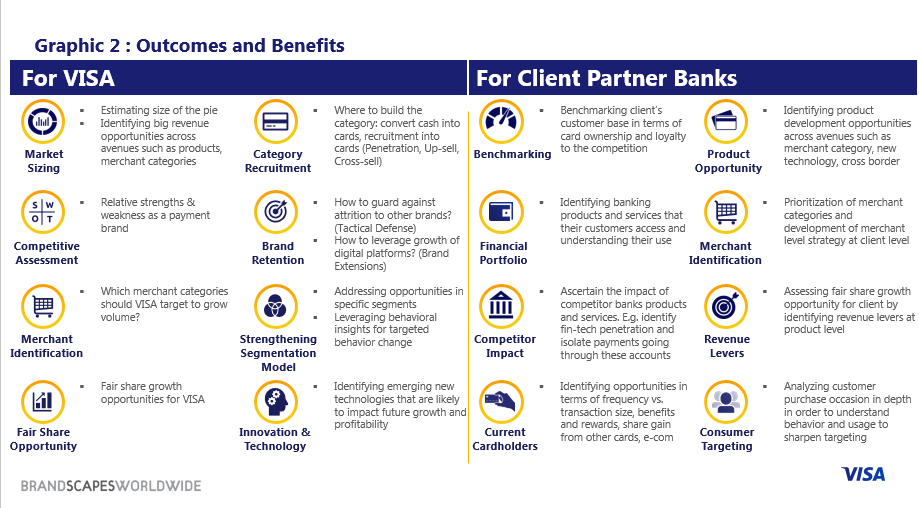
The outcomes and benefits of the studies to Visa and their client partners were clearly outlined. See Graphic 2.
Stage 1: Immersions
1A: Data immersion:
A comprehensive evaluation of published and internal data and reports, including consumer finance media, industry estimates and reports by regulators/ industry bodies, third-party research, Visa’s past research and internal transaction database.
1B: Stakeholder Immersions:
Extensive discussions with different stakeholders in Visa ranging from Marketing, Consulting, Product & Propositions, Merchant Solutions to Strategy.
The regulatory environment for payments and FinTech.
The structure of the market, including new-age tech solutions that are increasingly becoming mainstream.
Consumer attitudes, media usage and segments.
Industry perspective of the key challenges and the likely shape of the future.
The decisions that the CPL was to inform across these diverse internal stakeholders such as the key challenges faced by Visa’s bank partners, product design.
“We were able to use the immersion sessions to understand the key priorities of the research and how it would be applied to the business, both for Visa and its clients. For example, a key criterion of success for this project was the ability to overlay the data onto the multiple segmentations that are used across Visa, and this was an outcome of the immersion discussions”. Kulvir Benning, Marketing and Insights Manager, Visa Europe.
This stage also, importantly, served to disseminate the need for and value of the study within Visa and generated internal buy-in for the project.
Stage 2: Mapping the Payments Landscapes
This was in two phases:
A large-scale nationally representative sampling of over 12,000 individuals residing in the UK covered consumers’ banking habits, card ownership and usage, outbound travel payments, infrequent and periodic payments.
An app-based mobile diary was placed for a week among a sub-sample of over 4,000 consumers. Quotas were built into the sample to ensure robust reads for segments of special focus.
The diary and follow-ups were designed to capture details of over 120,000 payment and ATM transactions in real-time: what was bought, how was the payment made, why the payment mode was used and so on. The data from phase 1 enabled accurate attribution of the payment mode to enable us to cut the data in several ways including payment mode (cash, card, contactless, digital…), the bank issuing the card, merchant category where the payment was made, reasons for using specific card/ payment mode (or not), transaction amount and so on.
Stage 3: Calibration and triangulation
The data capture phase was followed by a crucial part of the project. The data captured through the two phases was consolidated, weighted, projected, and then calibrated and triangulated with external and internal data available from the immersion phase and with Visa’s databases. The result is a database that is not only unparalleled in its size and detail but also robust and reliable in terms of the payment volume of the various segments.
Outcomes Achieved:
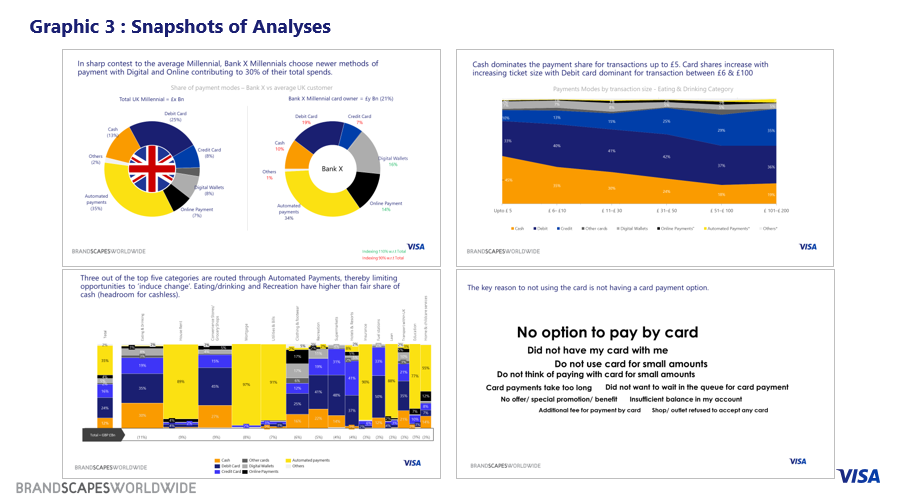
The Consumer Payments Landscape study data has been analysed using different lenses such as card-issuing banks, merchant categories, product (e.g. credit Vs. debit). We analysed the data to help facilitate discussions between Visa and their client partners and co-creating strategic and tactical initiatives. For confidentiality reasons, we are unable to name these partners or go into specific details, but some examples of the analyses are listed below, and snapshots are shown in Graphic 3.
Identification of opportunities and assessing threats for ‘traditional’ banks such as from nascent “neobanks”.
Propensity modelling to pinpoint the kind of customer most likely to convert to neobanks.
Identification and characterisation of opportunities for Visa in each consumer segment, age cohort, affluence level, regions.
Assessment of Visa’s strengths, weaknesses, and vulnerabilities.
Reassessing and sharpening Visa’s consumer segmentation with behavioural information from the CPL to feed into targeting strategies.
Designing products and rewards to resonate with key consumer segments of partner banks.
Informing the cross-selling strategies of partner banks.
Driving merchant category strategy for both Visa and their partner banks.
The multi-lens approach has resulted in analyses that cover different facets of the business
Partner Banks
Cash Displacement
Acceptance
Product Design: Debit, Credit, Contactless, Digital Wallets
Consumer migration up the value chain
Cross-selling
Up-selling
Share gain
Consumer Segmentation and Targeting
Communication
Further, Visa’s partner banks have expressed the desire to do follow-up work to hone-in into the implications thrown up by this exercise and different internal teams are developing propositions and service ideas specific to micro-segments.
“The CPL study has provided immensely valuable insights into the changing shape of the UK payments landscape! The study has allowed us to understand the full range of payment methods used by consumers, the relationship with their main bank versus other providers and most importantly the drivers for this. These insights are currently supporting the development of new propositions that will meet the differing needs of consumers taking account of their life stage and affluence”. Geoff Mozley, Commercial Account Manager, Visa UK.
Why should this entry win the award?
Innovation in the use of newer technology-based methodologies to ensure near real-time, accurate responses.
Proven validity of the data through calibration and triangulation.
Building on existing knowledge and practices such as the incorporation of multiple segmentations into the study to allow for flexible analysis.
Alignment of all internal stakeholders on objectives, outcomes, and design prior to designing the questionnaire.
The research enabled Visa to have a single market view across internal departments as well as external stakeholders.
“Visa has to navigate an evolving and subtle payments space. When we develop programs to encourage behaviour change, we need to be consumer-led. We need to understand the environment within which consumers make their decisions and this study enables us to do this. I see this as the first of a series of studies that will ultimately explore other audiences including merchants/ retailers plus wider SME/ business owners. Very excited by this first phase of our roadmap and look forward to sharing observations and recommendations with our partners.” Neil Rycraft, Head of Marketing Strategy & Operations, Visa Europe
Brandscapes have always been concerned about employee’s health. As part of that ethos, we conducted the first virtual Marathon to ensure that employees focus on their health and fitness.
The first virtual Marathon took place on July 5th, 2020. It included cycling, walking, and running. Brandscapes employees completed the 2k, 5k and 10k challenges successfully. Kudos to all who participated and showed their spirit of doing any fun race, be it running, cycling, or walking!
Vivek Sharma of Brandscapes Worldwide and Marie Wolfe of Unilever presented “Dating ideas for success” at NEXT 2020, the annual forward looking conference organized by the Insights Association. The Insights Association is a leading voice, resource and network of the marketing research and data analytics community, based out of the US